

OCD Treatment Whitby

OCD Therapist in Durham Region: OCD Treatment & ERP in Whitby

OCD Therapist in Durham Region: OCD Treatment & ERP in Whitby

If you're looking for an OCD therapist in Durham Region, finding a therapist with specialized training in OCD treatment can make an important difference.

At Cedar Tree Therapy in Whitby, Ontario, OCD is a specialized area of psychotherapy. Dana Etherington work with adults experiencing obsessive-compulsive disorder (OCD) and related illnesses.

Dana’s approach to OCD therapy is informed by specialized training in Exposure and Response Prevention (ERP) and related evidence-based behavioural treatments.

In-person OCD therapy in Whitby and virtual psychotherapy across Ontario are available, making treatment accessible to clients throughout Durham Region and beyond.

What Is OCD?

Obsessive-compulsive disorder (OCD) is a mental health condition involving obsessions, compulsions, or both.

Obsessions are unwanted and intrusive thoughts, images, sensations, or urges that cause distress. Compulsions are behaviours or mental rituals that a person feels driven to perform to reduce anxiety, prevent something bad from happening, or achieve a sense of certainty.

OCD can take many different forms.

Some common OCD themes include:

  • Contamination and illness

  • Fear of harming yourself or someone else

  • Relationship OCD (ROCD)

  • Sexual orientation OCD

  • Religious or moral OCD

  • Perfectionism

  • Fear of making a mistake

  • Responsibility for harm

  • Health anxiety and health-related OCD

  • Aggressive intrusive thoughts

  • Symmetry and "just right" OCD

  • Fear of losing control

  • Intrusive thoughts and images

OCD can also involve mental compulsions that are difficult for other people to see.

Someone with OCD may repeatedly review a conversation, analyze their feelings, seek reassurance, Google questions, mentally check their memories, compare possibilities, or try to prove that an intrusive thought isn't true.

These behaviours can become part of the OCD cycle even when there are no obvious outward rituals.

Having an intrusive thought does not mean you want it.

Intrusive thoughts are a common part of OCD. The presence of an unwanted thought does not mean that you believe it, want it, or that it reflects who you are.

Treatment focuses on changing your relationship with these thoughts rather than trying to eliminate every uncomfortable thought or achieve complete certainty.

OCD Treatment in Durham Region

One of the most important considerations when choosing an OCD therapist in Durham Region is whether the therapist has specific training in OCD treatment.

At Cedar Tree Therapy, OCD therapy incorporates evidence-based approaches, including Exposure and Response Prevention (ERP).

What Is ERP for OCD?

Exposure and Response Prevention (ERP) is a specialized form of cognitive behavioural therapy used in the treatment of OCD.

ERP involves gradually approaching situations, thoughts, sensations, or uncertainties that OCD has taught you to fear or avoid while reducing the compulsive behaviours you would normally use to feel safe or certain.

For example, treatment may involve reducing:

  • Reassurance seeking

  • Checking

  • Avoidance

  • Mental reviewing

  • Googling

  • Comparing

  • Confessing

  • Mental rituals

  • Repeatedly testing your feelings or reactions

The goal isn't to guarantee that you will never experience anxiety or intrusive thoughts again.

Instead, ERP helps you build the ability to experience uncertainty and discomfort without allowing OCD to dictate your behaviour.

ERP is individualized and developed collaboratively. Treatment is paced according to your clinical needs and goals.

Specialized Training in OCD and Related Conditions

Dana Etherington’s training includes specialized education in OCD, ERP, and related conditions through recognized professional organizations and training programs including:

  • Behavior Therapy Training Institute (BTTI) Intensive Training — International OCD Foundation (IOCDF). One of the most highly regarded OCD trainings in the world.

  • Body Dysmorphic Disorder (BDD) Training — International OCD Foundation (IOCDF)

  • Treatment of Co-Occurring OCD and Eating Disorders — International OCD Foundation (IOCDF)

  • ComB (Comprehensive Model for Behavioral Treatment) for Body-Focused Repetitive Behaviours (BFRBs) — International OCD Foundation (IOCDF)

  • Exposure and Response Prevention (ERP) for OCD — Canadian Association of Occupational Therapists (CAOT)

This specialized training complements her clinical experience providing psychotherapy for individuals experiencing OCD, anxiety, eating disorders, and related concerns.

A note on OCD and Eating Disorders

OCD and eating disorders can sometimes occur together, and distinguishing between the two can be complex.

Both can involve:

  • Rigid rules

  • Repetitive behaviours

  • Avoidance

  • Checking

  • Perfectionism

  • Intrusive thoughts

  • Difficulty tolerating uncertainty

  • A strong need for control

However, the reason a person engages in a particular behaviour matters.

For example, someone may repeatedly check, restrict, exercise, or seek reassurance because they are responding to an OCD obsession, an eating-disorder concern, or both.

How to Find the Right OCD Therapist in Durham Region

If you're searching for an OCD therapist in Durham Region, it can be helpful to ask a few questions before starting therapy.

Does the therapist have specialized OCD training?

OCD is a specialized area of psychotherapy. General experience treating anxiety does not necessarily mean a therapist has specific training in OCD or ERP.

Does the therapist understand mental compulsions?

Compulsions aren't always visible. A therapist familiar with OCD should understand mental rituals, reassurance seeking, rumination, checking, avoidance, and other less obvious compulsions.

Does the therapist use ERP?

If you're specifically looking for OCD treatment, ask how the therapist incorporates Exposure and Response Prevention (ERP) into their approach.

Does the therapist understand co-occurring conditions?

If you are experiencing OCD alongside an eating disorder, BDD, BFRBs, or anxiety, it may be helpful to work with someone who understands how these concerns can interact.

OCD Therapist in Whitby and Durham Region

Cedar Tree Therapy is located in Whitby, Ontario, and provides psychotherapy to adults throughout Durham Region.

In-person appointments are available in Whitby, and virtual psychotherapy is available across Ontario.

Dana work with adults experiencing OCD and related concerns, including anxiety, eating disorders, BDD, and BFRBs.

If you're searching for an OCD therapist in Durham Region, OCD therapist in Whitby, or an ERP therapist in Durham Region, specialized training and experience are important factors to consider when choosing a therapist.

You don't have to navigate OCD alone.

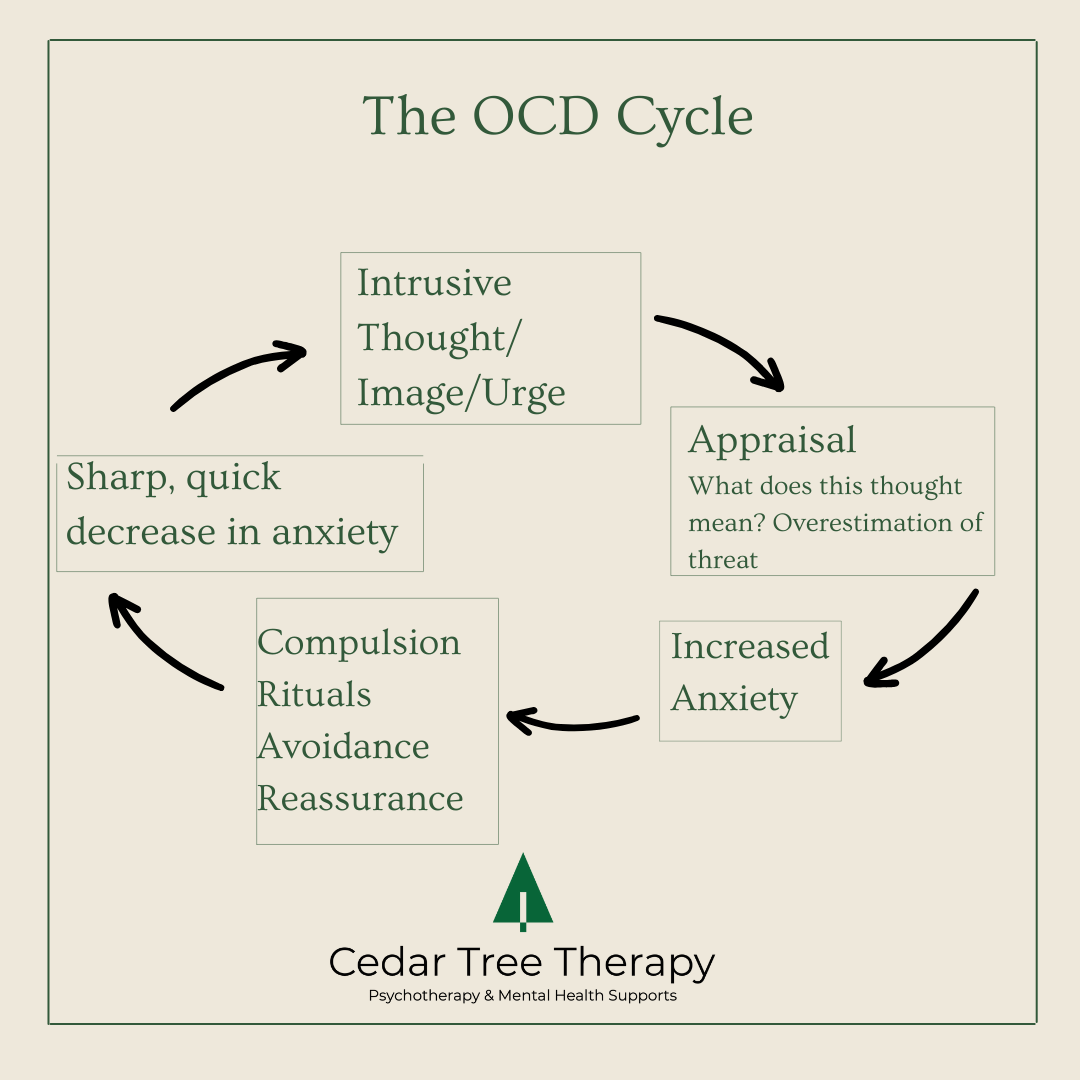
Therapy can help you understand the OCD cycle, reduce your reliance on compulsions and avoidance, and move toward a life that isn't dictated by OCD.

Looking for an OCD Therapist in Durham Region?

If you're looking for OCD therapy in Whitby or Durham Region, Cedar Tree Therapy provides specialized psychotherapy for adults experiencing OCD and related concerns.

In-person therapy is available in Whitby, with virtual therapy available across Ontario.

Learn more about OCD therapy or contact Cedar Tree Therapy to discuss whether treatment may be a good fit for you.
How Occupational Therapists Can Help Your OCD

How Occupational Therapists Can Use ERP to Help with Obsessive-Compulsive Disorder (OCD)

Understanding OCD and Its Impact

Obsessive-Compulsive Disorder (OCD) is a mental health condition characterized by unwanted, intrusive thoughts (obsessions) and repetitive behaviors or mental acts (compulsions) aimed at reducing anxiety or preventing a feared outcome. These symptoms can significantly interfere with daily routines, relationships, and quality of life.

Occupational Therapists play a vital role in the treatment of OCD—especially through the use of Exposure and Response Prevention (ERP), one of the most evidence-based treatments for OCD.

What Is Exposure and Response Prevention (ERP)?

ERP is a specialized form of Cognitive Behavioural Therapy (CBT) designed to help individuals gradually face their fears and resist the urge to engage in compulsions. The emphasis on this type of therapy is the behavioural component. Over time, this process helps the brain learn that anxiety naturally decreases without performing the rituals.

For example, someone who fears contamination might work toward touching a doorknob and refraining from washing their hands immediately afterward—under the supportive guidance of their therapist.

How Occupational Therapists Integrate ERP Into Practice

Occupational therapists are uniquely positioned to integrate ERP within the context of a person’s daily life and functional goals. Here’s how Occupational Therapists can effectively support clients with OCD:

1. Functional Assessment of Triggers

Occupational Therapists begin by understanding how obsessions and compulsions affect self-care, productivity, and leisure. For example, an individual might spend hours engaging in compulsions, struggle to complete work tasks due to intrusive thoughts, or avoid social situations out of fear their obsession might come true.

This holistic assessment helps tailor ERP exposures that are person-centered and directly related to meaningful life activities.

2. Graded Exposure Plans

Occupational Therapists collaborate with clients to design graded exposure hierarchies—lists of feared situations ranked from least to most distressing.
Some examples of behavioural exposures:

  • Touching an item perceived as “dirty” without immediately washing.

  • Leaving home without checking locks multiple times.

  • Using public restrooms or touching shared objects.

Through structured ERP sessions, the Occupational Therapist supports the client in approaching anxiety-provoking tasks safely and gradually, helping them regain confidence in everyday occupations. It is important to note that your therapist works through your hierarchy at your pace. Although it may feel challenging it should never be incredibly distressing. Your feedback throughout is important.

3. Response Prevention Strategies

In addition to exposure, Occupational Therapists integrate response prevention—refraining from performing compulsions such as handwashing, checking, or seeking reassurance.
The Occupational Therapist provides emotional regulation tools, grounding techniques, acceptance and mindfulness strategies to tolerate the discomfort that arises during exposure.

4. Building Daily Routines and Coping Skills

ERP alone is most effective when combined with occupational therapy’s focus on functional recovery. Occupational Therapists help clients rebuild balanced routines, improve sleep, eating, and self-care, and engage again in valued activities that OCD may have disrupted.

5. Collaborative, Holistic Care

Occupational therapists often work alongside psychologists, psychiatrists, and family members to ensure a coordinated approach. The Occupational Therapist’s focus on participation, autonomy, and quality of life helps bridge the gap between clinical progress and real-world functioning.

Benefits of ERP With an Occupational Therapist

  • Personalized treatment focused on your daily life and goals.

  • Supportive, practical guidance during real-world exposures.

  • Improved independence in home, work, and social settings.

  • Long-term anxiety reduction and increased tolerance for uncertainty.

Key Takeaway

ERP is one of the most effective, research-supported treatments for OCD—and occupational therapists are uniquely equipped to deliver it within the context of everyday living. By addressing both the emotional and functional aspects of OCD, OTs help clients reclaim their routines, relationships, and sense of control.

Frequently asked questions (FAq)

1. What is ERP therapy for OCD?
Exposure and Response Prevention (ERP) is a form of CBT that helps people face their fears and reduce compulsive behaviours by gradually exposing them to anxiety triggers without performing rituals.

2. Can occupational therapists provide ERP for OCD?
Yes. Occupational Therapists trained in mental health can integrate ERP techniques to help clients manage OCD symptoms while improving participation in daily activities.

3. How is ERP with an Occupational Therapist different from ERP with a general therapist?
While both use evidence-based ERP methods, Occupational Therapists focus on function and daily living, helping clients apply ERP skills in real-world contexts such as hygiene routines, work tasks, and social interactions. Its not just talking, we bring therapy to life.

4. How long does ERP treatment take?
ERP is typically delivered over several months to a year or more, depending on symptom severity and readiness for exposure. Progress is gradual but highly effective with consistent participation.

5. Is ERP effective for all types of OCD?
Yes. ERP has strong research support across various OCD presentations, including contamination fears, checking, intrusive thoughts, and symmetry obsessions.

Want more information about therapy for OCD? Check out this past blog post:

When Thoughts Feel Like Threats: Understanding Intrusive Thoughts

In our practice, we often meet people who’ve been carrying a secret fear for a long time, one they rarely speak aloud. It usually begins with a question:

“Why would I think something like that?”

Maybe you’ve had a sudden image flash through your mind. Maybe something violent, inappropriate, or completely unlike you. Or maybe a disturbing question loops through your thoughts all day, no matter how hard you try to stop it. These aren’t signs you’re broken. They’re called intrusive thoughts, and they’re more common, and more treatable than most people realize.

This post explores what intrusive thoughts are, why they happen, how they show up in real life, and how Cedar Tree Therapy helps clients regain peace of mind.

What Are Intrusive Thoughts?

Intrusive thoughts are unwanted mental events: images, ideas, impulses, or doubts that feel jarring and uncomfortable. They show up suddenly, often at the worst times, and tend to focus on taboo or fear-inducing themes. What makes them especially upsetting is that they seem to contradict your values or identity.

Examples Include:

  • “What if I swerve my car into traffic?”

  • “What if I touched something toxic and didn’t realize it?”

  • “What if I accidentally harmed someone?”

  • “Do I really love my partner, or is something wrong with me?”

  • “What if I’m secretly a bad person?”

These thoughts can feel so out-of-place and intense that people begin questioning their character, morality, or mental stability.

Important Note: Everyone has random thoughts, but for people with OCD or anxiety disorders, these thoughts become distressing obsessions. The brain reacts as though the thought itself is a threat.

Why Are Intrusive Thoughts So Disturbing?

Let’s be clear: intrusive thoughts don’t feel random. They feel dangerous, personal, and urgent. This is where the obsessive-compulsive cycle can take hold.

How It Typically Plays Out:

  1. An intrusive thought occurs: “What if I just screamed in this quiet room?”

  2. You feel anxiety, guilt, or shame: “What’s wrong with me?”

  3. You try to make the thought go away: by checking, avoiding, praying, confessing, or mentally analyzing, engaging in compulsions

  4. Temporary relief … until the thought returns

OCD Treatment Therapy Whitby

This pattern is exhausting and can make a person feel like they’re constantly at war with their own mind. The real problem isn’t the thought itself, it’s the meaning the brain assigns to it and the desperate effort to make it go away.

Common Themes of Intrusive Thoughts

At Cedar Tree Therapy, we help people work through all kinds of intrusive thought content. While no two experiences are exactly alike, here are some of the most common themes:

1. Harm OCD

  • Fears about accidentally or intentionally harming someone

  • E.g., “What if I dropped my baby?” or “What if I stabbed someone?”

2. Sexual Intrusive Thoughts

  • Disturbing sexual images or fears related to taboo topics

  • These thoughts are particularly shame-inducing but don’t reflect desires

3. Religious or Moral OCD (Scrupulosity)

  • Obsessions about sinning, being impure, or violating moral rules

4. Contamination OCD

  • Fears of germs, illness, or spreading harm through touch or presence

5. Relationship OCD (ROCD)

  • Endless doubt about whether you're in the "right" relationship

6. Existential OCD

  • Obsessive questioning about life, reality, consciousness, or death

Why Do Intrusive Thoughts Happen?

Intrusive thoughts are a byproduct of a high-functioning, threat-sensitive brain. The human brain constantly scans for danger and sometimes, especially in people with OCD or high anxiety, it over-fires.

  • For example: A parent with strong moral values imagines harming their child and feels horrified. Their anxiety goes up, and their brain mistakenly assumes the thought itself is dangerous.

  • Result: They avoid being alone with the child, seek reassurance, or mentally review every interaction—just to feel safe.

This reinforces the idea that the thought was dangerous and should be avoided, thus keeping the cycle going.

The Role of Shame

One of the most painful aspects of intrusive thoughts is the isolation they cause. People don’t talk about them, not even with close friends or partners because they’re afraid they’ll be misunderstood.

At Cedar Tree Therapy, we emphasize this truth with our clients:

Intrusive thoughts show you your values—not your desires.

OCD loves to latch onto the things that you value the most. Of course you would want to protect what you value and experience fear, anxiety and distress if those things are threatened by your thoughts. You’re not broken. You’re someone with a brain that’s reacting to stress or trauma.

What Helps: How We Treat Intrusive Thoughts

1. ERP (Exposure and Response Prevention)

ERP is the gold-standard treatment for OCD and intrusive thoughts. In ERP, you practice allowing the thoughts to exist without doing the usual rituals (checking, avoiding, seeking reassurance). ERP is highly structured, and at Cedar Tree Therapy, we deliver it gently, with your full collaboration and consent.

2. Mindfulness and Acceptance-Based Approaches

Mindfulness helps you observe thoughts like passing weather, not personal attacks. Instead of “fixing” every thought, you practice saying:

“There’s that thought again. I don’t have to do anything about it.”

This takes practice, but over time it builds cognitive flexibility—the ability to stay grounded, even when the mind gets loud.

3. Trauma-Informed Care

For clients with past trauma, intrusive thoughts can carry an even heavier emotional load. Our therapists are trained to spot trauma-related patterns and work at a pace that feels safe, respectful, and empowering.

4. Self-Compassion Work

Shame feeds the OCD cycle. Self-compassion helps unwind it. You’ll learn to talk to yourself the way you would talk to a friend in the same situation.

How to Talk About Intrusive Thoughts (Without Fueling Them)

Talking about intrusive thoughts can help—but how you talk about them matters. If you’re constantly seeking reassurance from friends, partners, or Google, you might unintentionally be reinforcing the OCD cycle.

Instead, focus on:

  • Naming the thought (“This is an intrusive thought”)

  • Noticing the urge to check or neutralize

  • Practicing gentle redirection (“I'm choosing not to feed this loop today”)

Building a Safe Container for Healing

Therapy is about more than tools—it’s about relationship. At Cedar Tree Therapy, we don’t just give you coping strategies; we provide a safe, grounded space to explore what these thoughts mean to you, how they’ve impacted your life, and how you want to move forward.

We use a collaborative, non-pathologizing approach. You’ll never be rushed. You’ll never be shamed. You’ll always be treated as the expert on your own experience.

Frequently Asked Questions

Are intrusive thoughts normal?

Yes. Nearly everyone has intrusive thoughts. But for those with OCD or anxiety disorders, they become sticky and distressing.

Do intrusive thoughts mean I want to act on them?

No. In fact, the more distressed you are by a thought, the less likely you are to act on it.

Can therapy really help?

Absolutely. With proper support, clients can reduce the power of intrusive thoughts, develop a healthier relationship with their mind, and regain control of their lives.

Final Words

You are not your thoughts.
You are not alone.
And healing is possible.

If intrusive thoughts have been running your life, it might be time to take back the reins with support that feels steady, respectful, and rooted in understanding. Whether you’re looking for ERP, trauma-informed therapy, or simply someone who gets it, we’re here for you.

Ready to Begin?