For Therapists

Clinical Supervision for OCD Therapists in Ontario

Providing therapy for obsessive-compulsive disorder (OCD) can be deeply rewarding work, but it also requires specialized clinical skills, strong case conceptualization, and confidence navigating complex presentations. For many clinicians, clinical supervision becomes one of the most valuable ways to continue developing competence in OCD treatment while feeling more supported in their work.

Whether you are a new therapist building confidence with exposure and response prevention (ERP) or an experienced clinician looking to deepen your approach to OCD treatment, clinical supervision for OCD therapists in Ontario can help strengthen both your skills and your clinical confidence.

Why Clinical Supervision Is Important for OCD Therapists

OCD is often misunderstood, misdiagnosed, or missed entirely in therapy. Clients may present with intrusive thoughts, reassurance seeking, perfectionism, rumination, compulsions, avoidance, or intense uncertainty that overlaps with anxiety disorders, eating disorders, trauma, or depression.

Because OCD can present in so many different ways, therapists often benefit from ongoing supervision focused specifically on OCD treatment and case conceptualization.

Clinical supervision for OCD therapists can help clinicians:

  • improve OCD case conceptualization skills

  • strengthen ERP interventions

  • recognize subtle compulsions and reassurance patterns

  • navigate client’s subtle (or not so subtle) avoidance

  • build confidence working with intrusive thoughts

  • support clients with complex or overlapping diagnoses

  • improve therapeutic pacing and exposure planning

  • develop greater confidence in OCD treatment

For therapists in Ontario, supervision can also provide support navigating ethical considerations, scope of practice, documentation, and professional identity while working in private practice, community mental health, or hospital settings.

Developing Confidence With Exposure and Response Prevention (ERP)

Exposure and response prevention is considered one of the most effective treatments for OCD, but many therapists feel anxious implementing ERP without support or consultation.

Clinical supervision creates space to collaboratively:

  • develop individualized exposure hierarchies

  • troubleshoot stuck points in treatment

  • explore therapist anxiety around exposures

  • improve response prevention strategies

  • increase flexibility in ERP interventions

  • balance behavioural work with therapeutic rapport

Many therapists report that supervision helps them feel more grounded and effective when providing ERP therapy for OCD.

Support for Complex OCD Presentations

OCD frequently co-occurs with other mental health concerns, which can make treatment more nuanced. Therapists may be supporting clients with:

  • eating disorders and OCD

  • health anxiety and OCD

  • perfectionism and obsessive traits

  • trauma and OCD

  • panic disorder

  • generalized anxiety

  • neurodivergence

  • depression and suicidality

Clinical supervision for OCD therapists in Ontario can help clinicians better understand these overlapping presentations while maintaining a clear treatment direction.

Clinical Supervision for Newer Therapists

Clinical Supervision is essential for new grads. Many newer therapists want additional support before diving into OCD treatment. In combination with continuing education, supervision can help newer clinicians:

  • build confidence with OCD assessments

  • understand compulsions and mental rituals

  • strengthen therapeutic boundaries

  • develop confidence tolerating uncertainty in session

  • learn how to avoid unintentional reassurance

Supervision also provides an opportunity to ask questions openly, process difficult sessions, and continue developing practical clinical skills in a supportive environment.

Benefits of OCD Supervision for Experienced Therapists

Even experienced therapists benefit from ongoing clinical consultation and supervision. OCD work can be highly nuanced, especially when clients present with:

  • harm OCD

  • relationship OCD (ROCD)

  • contamination OCD

  • scrupulosity

  • existential OCD

  • sensorimotor OCD

  • intrusive sexual thoughts

  • taboo obsessions

You can read more about what therapy looks like for OCD here. Ongoing supervision supports therapists in refining their approach, deepening clinical insight, and staying connected to best practices in OCD treatment.

Finding Clinical Supervision for OCD Therapists in Ontario

When looking for clinical supervision for OCD therapists in Ontario, it can be helpful to find a supervisor with experience in:

  • obsessive-compulsive disorder treatment

  • exposure and response prevention (ERP)

  • anxiety disorders

  • eating disorders

  • psychotherapy supervision

  • complex case conceptualization

  • private practice support

  • therapist skill development

The right supervision relationship should feel collaborative, supportive, and growth-oriented while also helping therapists strengthen their clinical competence and confidence.

Final Thoughts

Clinical supervision for OCD therapists in Ontario offers more than case consultation. It provides a space for therapists to deepen their understanding of OCD, strengthen ERP skills, improve case conceptualization, and continue growing as clinicians.

Whether you are newly learning OCD treatment or expanding an existing specialization, ongoing supervision can help you feel more confident, intentional, and supported in your work with clients experiencing OCD. You can read more about Dana Etherington, Clinical Supervisor, here.

Why Clinical Supervision Really Matters for Eating Disorder Therapists

Clinical Supervision for Eating Disorder Therapists in Ontario

Working with eating disorders can feel very different from other areas of therapy. Sessions often involve layers of complexity: medical concerns, emotional avoidance, perfectionism, family dynamics, trauma, OCD traits, shame, and deeply ingrained coping strategies that clients may not fully want to let go of.

Many therapists enter eating disorder work because they care deeply about helping clients recover, but quickly realize how isolating and high-pressure the work can become without proper support.

That’s where clinical supervision matters.

Good supervision gives therapists a place to slow down, think critically about cases, build confidence, and make sense of the moments where treatment feels unclear or stuck. It is not just about getting advice. It is about developing stronger clinical judgment and learning how to hold complex cases in a sustainable way.

Why Eating Disorder Work Requires Specialized Supervision

Eating disorders are rarely straightforward.

A client may say they want recovery while simultaneously feeling terrified of change. Another may appear medically stable while emotionally deteriorating. Some clients intellectualize their emotions, while others struggle to identify them altogether.

Therapists are often balancing several things at once:

  • Behavioural symptoms and risk management

  • Emotional processing and attachment dynamics

  • Trauma histories and nervous system regulation

  • Co-occurring OCD, anxiety, depression, or perfectionism

  • Family accommodations and relational patterns

  • Medical concerns that require collaboration with outside providers

Because of this, eating disorder therapy is rarely “one modality fits all.”

Most clinicians naturally find themselves integrating approaches such as:

  • DBT for emotion regulation and distress tolerance

  • EFT or attachment-focused work for relational patterns

  • Parts work and internal systems approaches

  • Trauma-informed interventions

  • Behavioural strategies and exposure-based work

Supervision can help therapists understand not only what intervention to use, but why it may or may not be working for a particular client.

Common Challenges Therapists Face in Eating Disorder Treatment

Even experienced therapists can feel uncertain when working with eating disorders.

Some of the most common supervision themes include:

  • Feeling stuck with client ambivalence toward recovery

  • Worrying about saying the “wrong” thing around food, weight, or body image

  • Difficulty assessing risk

  • Navigating ego-syntonic symptoms

  • Managing countertransference

  • Uncertainty around scope of practice or referrals

  • Supporting families without reinforcing the eating disorder

These are not signs of incompetence. They are part of the reality of doing complex clinical work.

Strong supervision helps therapists move from self-doubt toward clearer case understanding and more intentional intervention.

What Makes Clinical Supervision Actually Helpful?

Not all supervision feels useful.

Some therapists leave supervision sessions feeling validated but without a clearer sense of direction. Others may receive generic feedback that doesn’t reflect the realities of eating disorder treatment.

Helpful supervision should feel collaborative, practical, and clinically grounded.

Specialized Experience Matters

A supervisor working in this area should have direct experience treating eating disorders across different levels of care.
Dana Etherington brings experience from residential and inpatient eating disorder treatment settings in Ontario. This allows her to bring a stronger understanding of risk assessment, treatment pacing, behavioural reinforcement cycles, family dynamics as well as collaboration with dieticians, physicians, and psychiatrists. Dana is also a National Eating Disorder Information Centre (NEDIC) member and is a featured provider with the Eating Disorder Association of Canada (EDAC).

Strong Case Conceptualization

Good supervision goes beyond simply discussing what happened in session.

Therapists should leave with:

  • A clearer understanding of maintaining factors

  • More direction for treatment planning

  • Greater confidence in clinical decision-making

  • Practical next steps for intervention

Case conceptualization becomes especially important in eating disorder work because symptoms often serve multiple functions at once.

Integration Over Rigid Modality Use

Many therapists feel pressure to “pick a modality” and follow it perfectly.

In reality, eating disorder treatment often requires flexibility.

A client may need behavioural work one week, attachment-focused exploration the next, and nervous system regulation strategies during moments of overwhelm.

Supervision can help therapists integrate approaches in a way that still feels clinically coherent.

Support for Therapist Development

Newer clinicians often carry a significant amount of anxiety into eating disorder work.

Questions like:

  • “Am I doing this right?”

  • “Is this beyond my competence?”

  • “What should my role actually be?”

are incredibly common.

Good supervision creates space for those conversations without shame or judgment.

The Benefits of Ongoing Clinical Supervision

Consistent clinical supervision can have a meaningful impact on both therapist development and client care. Over time, many therapists find themselves feeling more confident managing complex or high-risk situations, while also gaining a stronger understanding of treatment resistance, ambivalence, and the factors that may be maintaining the eating disorder.

Supervision can also strengthen clinical reasoning and help therapists make more intentional decisions about interventions, pacing, and treatment planning. Rather than feeling pressured to “get it right” in every session, therapists often develop a greater ability to tolerate uncertainty and approach difficult cases with more flexibility and clarity.

Beyond clinical skill development, supervision also plays an important role in therapist sustainability. Eating disorder work can be emotionally demanding, particularly when therapists are holding risk, navigating slow progress, or working with clients who feel deeply stuck. Having a consistent space for reflection and support can reduce feelings of burnout, self-doubt, and emotional overwhelm.

For many clinicians, supervision not only improves the quality of their work, but also helps them reconnect with a sense of confidence, enjoyment, and longevity in the work they do.

Clinical Supervision in Ontario

For therapists practicing in Ontario, supervision can also support:

  • CRPO psychotherapy competency development

  • Scope expansion into eating disorder treatment, along with continuing education

  • Ethical and regulatory decision-making

  • Ongoing professional growth

  • Consultation around risk and interdisciplinary collaboration

This is especially important in eating disorder treatment, where medical risk and psychological complexity often overlap.

Working within competence is not about knowing everything. It is about recognizing when consultation, supervision, or collaboration is needed.

What Happens During a Supervision Session?

Supervision sessions are often a mix of practical strategy, clinical reflection, and collaborative problem-solving. Rather than simply talking through a difficult session, the focus is usually on understanding the bigger picture of the case and helping therapists feel more confident in their clinical direction.

A supervision session may involve reviewing a case conceptualization, exploring the factors that are maintaining the eating disorder, and identifying where treatment may be feeling stuck. Therapists often bring questions about intervention choices, risk management, referrals, or how to navigate challenging dynamics that arise in session. There may also be space to reflect on therapist reactions, uncertainty, countertransference, or the emotional impact of the work itself.

The goal is not to have all the answers or to approach cases perfectly. The goal is to help therapists feel more grounded, intentional, and clinically clear in the work they are doing.

Dana also offers a free Case Conceptualization Template designed specifically for eating disorder work from a trauma-informed lens.

Who Benefits From Eating Disorder Supervision?

Clinical supervision can be especially valuable for:

Eating disorder treatment requires nuance, flexibility, and ongoing support. Rarely is a therapist expected to navigate complex cases entirely on their own. Clinical supervision provides space to think critically, strengthen clinical skills, and develop confidence in the work. Over time, that support often translates into more grounded therapists, stronger therapeutic relationships, and better care for clients. For therapists wanting to deepen their eating disorder work in an ethical and sustainable way, quality supervision can make a significant difference.

Looking for Clinical Supervision for Eating Disorder Therapists in Ontario?

If you are looking for supervision focused on:

  • Eating disorder case conceptualization

  • Integrative and evidence-based approaches

  • OCD, trauma, and co-occurring presentations

  • Building confidence and clinical clarity

  • Sustainable long-term clinical growth

Consider working with a supervisor who understands both the complexity of ED treatment and the developmental needs of therapist. You can read more about Dana Etherington, Clinical Supervisor, here.


  • It is highly recommended. Eating disorders are a unique blend of mental health and physical health risks, requiring specialized care.

  • Clinical supervision can help eating disorder therapists strengthen case conceptualization, manage risk more confidently, and navigate complex presentations such as OCD, trauma, perfectionism, and ambivalence toward recovery.

  • This depends on your level of experience. For RP(Q)s, the CRPO gives the guideline of 1 hour of supervision per approximately every 4 clients seen.

Psychotherapy Supervision for New Graduates in Ontario: What You Need to Know

Starting your career as a psychotherapist in Ontario can feel both exciting and overwhelming. After years of education and training, many new graduates quickly realize that real-world clinical work is far more complex than expected.

If you’re searching for supervision for new grads in Ontario, you’re in the right place. Dana Etherington is psychotherapist with 10 years of experience that has a special interest in working with new graduate supervisees.

Clinical supervision is one of the most important investments you can make early in your career. It’s not just about meeting regulatory requirements. It’s about building confidence, competence, and a strong professional identity.

Why New Graduates in Ontario Need Clinical Supervision

Most psychotherapy and mental health training programs provide a strong theoretical foundation. However, many new therapists still struggle with:

  • Translating theory into real-world practice

  • Knowing what to do when sessions feel “stuck”

  • Managing risk, boundaries, and clinical decision-making

  • Navigating imposter syndrome and self-doubt

In Ontario, whether you’re working toward registration with the College of Registered Psychotherapists of Ontario or practicing as a therapist in another regulated profession, ongoing clinical supervision is essential for safe, ethical, and effective care.

What to Look for in Clinical Supervision in Ontario

Not all supervision is created equal, especially for new graduates.

If you’re looking for clinical supervision in Ontario, your supervision should go beyond case review. It should actively support your development as a therapist.

1. Support with Case Conceptualization

Strong supervision helps you understand why your client is struggling—not just what is happening. This allows you to create more effective, individualized treatment plans.

2. Help When You Feel Stuck

Every therapist experiences moments of uncertainty. Good supervision helps you work through these blocks, rather than just giving advice.

3. Integration of Therapeutic Modalities

Whether you practice CBT, ACT, EFT, or another modality, supervision should help you apply your approach in a way that feels natural and effective.

4. Development of Your Clinical Identity

Many new graduates in Ontario struggle with defining their role, especially in interdisciplinary settings. Supervision should help you clarify how you practice and what you bring to your work.

5. A Space to Reflect and Process

Therapy is emotionally demanding. Supervision should provide space to reflect on your reactions, prevent burnout, and sustain your work long-term.

Common Mistakes New Graduates Make with Supervision

When seeking supervision for new therapists in Ontario, many new grads fall into the same traps:

Trying to “perform” in supervision
You don’t need to have everything figured out. The most valuable supervision happens when you bring uncertainty, not perfection.

Waiting too long to start supervision
Early supervision helps you build confidence faster and prevents problematic patterns from developing.

Choosing supervision based only on cost or availability
Fit matters. A strong supervisory relationship should feel collaborative, supportive, and growth-oriented. It’s understandable that as a new graduate, cost can be a concern. Feel free to inquire about rates for new gradates that might work for you.

How to Get the Most Out of Clinical Supervision

If you want to maximize your supervision experience in Ontario:

  • Come prepared with a structured case conceptualization

  • Identify where you feel stuck or unsure

  • Be open to reflection and feedback

  • Focus on growth, not performance

Supervision works best when it’s an active, collaborative process.

Finding the Right Clinical Supervisor in Ontario

When looking for clinical supervision in Ontario for new graduates, consider:

  • Experience working with early-career therapists

  • Familiarity with CRPO requirements (if applicable)

  • Alignment with your therapeutic approach

  • A style that balances support and challenge

The right supervisor won’t just help you “get your hours”, they’ll help you become the therapist you want to be.

Start Your Career with the Right Support

The transition from student to practicing therapist is one of the most important phases of your career. You don’t need to navigate it alone.

Investing in psychotherapy supervision for new graduates in Ontario can help you feel more confident, competent, and grounded in your work.

If you’re looking for supportive, structured, and growth-focused clinical supervision in Ontario, reach out to learn more about working together.

  • Yes. If you are working toward registration with the College of Registered Psychotherapists of Ontario or practicing psychotherapy within another regulated profession, clinical supervision is expected as part of safe and ethical care.

    Supervision helps ensure that new therapists:

    • Practice within their scope

    • Manage risk appropriately

    • Continue developing clinical competence

    Even beyond regulatory requirements, supervision is strongly recommended during the first years of practice and beyond.

  • Clinical supervision is a structured, collaborative process where a more experienced clinician supports your development as a therapist.

    For new graduates in Ontario, supervision typically includes:

    • Case conceptualization support

    • Guidance on interventions and treatment planning

    • Help navigating ethical and professional issues

    • Reflection on therapeutic relationships and dynamics

    • Feedback to build confidence and clinical judgment

    Good supervision is not just oversight, it’s an active learning process.

  • If you’re searching for clinical supervision in Ontario as a new graduate, look for these core elements:

    Clear Case Conceptualization: You should leave supervision with a better understanding of your client’s patterns, not just a list of techniques.

    Support When You Feel Stuck: Supervision should help you think through uncertainty, not just tell you what to do.

    Integration of Your Modality: Whether you use CBT, ACT, EFT, or integrative approaches, supervision should help you apply your framework in real sessions.

    Development of Clinical Confidence: You should feel more grounded in your decision-making over time.

    Space for Reflection: Supervision should include attention to your emotional responses and the impact of the work.

  • Most new therapists benefit from weekly or biweekly supervision, depending on caseload and experience level. The CRPO offers the guideline ratio of one hour of clinical supervision per 4 clients treated.

Clinical Supervision for Therapists in Ontario: A Complete Guide to Ethical, Effective, and Growth-Oriented Supervision

Clinical Supervision for Therapists in Ontario: A Complete Guide to Ethical, Effective, and Growth-Oriented Supervision

If you’re a therapist in Ontario, you know that you need clinical supervision. Most therapists I work with aren’t just looking to check a box, they’re looking for something that actually helps them feel more confident, clear, and supported in their work.

Because the reality is this:
Good supervision changes how you practice.

It impacts how you show up in session, how you think about your clients, and how confident you feel making clinical decisions—especially when things get complex.

What Clinical Supervision Should Feel Like

Clinical supervision, at its best, isn’t about feeling evaluated or judged.

It’s a space where you can:

  • Talk openly about your cases (including the ones you feel stuck in)

  • Reflect on your patterns as a therapist

  • Get practical, usable feedback based in theory and evidence

  • Feel supported as you grow

In Ontario, supervision also needs to align with the expectations of the College of Registered Psychotherapists of Ontario (CRPO) , the Ontario College of Social Workers and Social Service Workers (OCSWSSW) and the College of Occupational Therapist of Ontario (COTO).

But beyond meeting those requirements, supervision should actually help you become a better therapist—not just a compliant one.

Why Clinical Supervision Matters More Than Most Therapists Expect

A lot of therapists come into supervision thinking they just need hours.

What they actually need is a place to:

  • Work through self-doubt and imposter syndrome

  • Get unstuck with clients that activate something in you

  • Strengthen their clinical judgment

  • Feel less alone in the work

Especially if you’re working with anxiety, OCD, or eating disorders where cases can get complex quickly.

Having a space to slow down, reflect, and think critically about your work makes a huge difference. Not just for you, but for your clients.

What I See Therapists Struggle With (Before Good Supervision)

Most therapists don’t need more training, they need better support integrating what they already know.

Before finding the right supervision, I often see therapists:

  • Overthinking what to say in session

  • Second-guessing their clinical decisions

  • Feeling unsure if they’re “doing it right”

  • Avoiding more complex cases

  • Feeling isolated in private practice

Supervision should directly address these things.

Not by giving you scripts—but by helping you think like a confident, grounded clinician.

What to Look for in Clinical Supervision in Ontario

If you’re looking for clinical supervision for therapists in Ontario, here’s what actually matters:

Alignment with CRPO, COTO & OCSWSSW

This is foundational. Your supervision should meet documentation and ethical standards, without you having to chase that clarity yourself.

If you want a deeper breakdown of this, I go into more detail on CRPO-aligned supervision in this post.

A Non-Judgmental Space

You should be able to bring your uncertainty, your mistakes, and your questions without feeling judged or criticized.

That’s where real growth happens.

Relevant Clinical Expertise

If you’re working with anxiety, OCD, or eating disorders, it helps to have a supervisor who understands the nuances of that work.

It allows supervision to go deeper and be immediately useful.

Support Beyond Clinical Work

For many therapists in Ontario, supervision is happening alongside building a private practice.

That often includes:

  • Figuring out your niche

  • Growing your caseload

  • Understanding how to market yourself (without it feeling inauthentic)

This is something that’s often missing from traditional supervision, but makes a big difference long-term.

Individual vs. Group Supervision

Both have value, and many therapists benefit from a mix of the two.

Individual supervision gives you space to go deep into your cases and your development.

Group supervision helps you learn from other therapists, gain perspective, and feel less alone in the work.

Neither is better, it depends on what you need at the stage you’re in.

How the Right Supervision Changes Your Practice

When supervision is actually working, you’ll notice:

  • You feel more confident in sessions

  • You’re clearer in your clinical decisions

  • You’re less reactive and more intentional

  • You can sit with complexity without feeling overwhelmed

  • You trust yourself more as a therapist

That shift is what most therapists are really looking for.

If You’re Looking for Clinical Supervision for Therapists in Ontario

The fit matters.

You want a supervisor who helps you:

  • Think more clearly

  • Feel more confident

  • Grow in a way that aligns with how you actually want to practice

If you want to get a sense of how I approach supervision (and what makes it CRPO-aligned), you can read more here.

To learn more about working together, click the link below.

Psychotherapy Clinical Supervision Ontario for Therapists (OTs, MSWs, and RPs)

If you are a therapist in Ontario looking for clinical supervision for psychotherapy, you are welcome to book a complimentary 15 minute consultation to determine if I would be a good fit as your clinical supervisor. I love hearing from you, and I am always open to hearing your questions. Let’s chat !

Psychotherapy clinical supervision in Ontario is an essential part of ethical psychotherapy practice. Many therapists—including Registered Psychotherapists, Registered Social Workers (MSWs), and Occupational Therapists practicing psychotherapy—seek ongoing clinical supervision to strengthen their clinical skills, receive consultation on complex cases, and ensure their work meets professional standards.

For therapists across Ontario, psychotherapy clinical supervision provides a structured space to reflect on therapeutic work, develop clinical insight, and maintain accountability in practice.

Whether you are an early-career therapist completing supervision hours or an experienced clinician in private practice, engaging in psychotherapy clinical supervision can significantly improve both therapist confidence and client outcomes.

What Is Psychotherapy Clinical Supervision?

Psychotherapy clinical supervision is a collaborative professional relationship in which therapists meet regularly with an experienced clinician to review clinical work and receive feedback.

Clinical supervision often includes:

  • Case consultation and treatment planning

  • Discussion of therapeutic interventions

  • Ethical decision-making support

  • Reflective practice and therapist self-awareness

  • Development of psychotherapy skills

For therapists working independently or in private practice, psychotherapy clinical supervision provides an important layer of professional accountability and support.

Who Seeks Psychotherapy Clinical Supervision in Ontario?

Therapists from multiple professional backgrounds seek psychotherapy supervision in Ontario. Most regulatory bodies have some requirement of supervision, however they all differ slightly in the number of hours required.

Registered Psychotherapists and RP (Qualifying)

Therapists registered with the College of Registered Psychotherapists of Ontario must complete supervised clinical practice hours before becoming fully registered Registered Psychotherapists.

Clinical supervision helps RP (Qualifying) therapists develop competency in:

  • therapeutic alliance

  • case conceptualization

  • treatment planning

  • ethical psychotherapy practice

Many Registered Psychotherapists also continue supervision throughout their careers as part of ongoing professional development.

Social Workers and MSWs Providing Psychotherapy

Many Master of Social Work (MSW) clinicians provide psychotherapy services in Ontario and benefit from engaging in psychotherapy clinical supervision.

Therapists registered with the Ontario College of Social Workers and Social Service Workers may seek supervision to strengthen psychotherapy skills, receive consultation on complex cases, and support reflective practice.

Clinical supervision can be particularly valuable for MSWs working in:

  • private practice psychotherapy

  • trauma therapy

  • anxiety and OCD treatment

  • eating disorder treatment

Supervision provides an opportunity to deepen clinical formulation skills and integrate different psychotherapy approaches into practice.

Occupational Therapists Practicing Psychotherapy

Occupational therapists who offer psychotherapy services also frequently participate in psychotherapy supervision.

Therapists registered with the College of Occupational Therapists of Ontario may seek psychotherapy supervision to ensure their work aligns with professional practice standards and to strengthen clinical psychotherapy skills.

Because psychotherapy often involves complex emotional and relational dynamics, supervision provides valuable support for therapists integrating psychotherapy into occupational therapy practice.

Benefits of Psychotherapy Clinical Supervision

Engaging in psychotherapy clinical supervision in Ontario offers several important benefits for therapists.

Stronger Clinical Skills

Regular supervision allows therapists to refine therapeutic techniques and develop stronger clinical judgment.

Ethical and Professional Support

Supervision helps therapists navigate ethical dilemmas, confidentiality questions, and challenging therapeutic dynamics.

Improved Client Outcomes

By reviewing cases and treatment approaches, therapists can ensure they are providing thoughtful, effective care for their clients.

Reduced Professional Isolation

Many therapists in private practice find that clinical supervision helps reduce isolation and provides an important space for professional reflection.

Virtual Psychotherapy Clinical Supervision in Ontario

Many therapists now access virtual psychotherapy clinical supervision across Ontario.

Virtual supervision allows therapists to work with supervisors regardless of location, making it easier for clinicians in Toronto, Ottawa, Hamilton, Durham Region, and across Ontario to access experienced supervisors.

Virtual psychotherapy supervision offers several advantages:

  • flexible scheduling

  • access to specialized supervisors

  • convenient supervision for private practice therapists

  • increased accessibility across the province

When structured effectively, virtual supervision provides the same reflective and collaborative learning environment as in-person supervision.

How to Choose a Psychotherapy Clinical Supervisor in Ontario

Finding the right psychotherapy clinical supervisor in Ontario can make a significant difference in your professional development.

When selecting a supervisor, therapists often consider:

Clinical experience
A supervisor who has experience treating similar client populations.

Regulatory knowledge
Supervisors familiar with expectations from the College of Registered Psychotherapists of Ontario, the Ontario College of Social Workers and Social Service Workers, or the College of Occupational Therapists of Ontario.

Supervision style
A reflective and collaborative supervision approach that supports clinical growth.

Professional fit
Feeling comfortable discussing challenges openly and honestly.

A strong supervisory relationship supports both clinical competence and therapist confidence.

Finding Psychotherapy Clinical Supervision in Ontario

If you are searching for psychotherapy clinical supervision in Ontario, it can be helpful to look for supervisors who:

  • work with therapists across multiple disciplines

  • understand psychotherapy practice standards

  • offer structured and consistent supervision

  • provide consultation for therapists in private practice

Supervision can play a vital role in supporting ethical, competent psychotherapy practice throughout a therapist’s career.

Therapists looking for psychotherapy clinical supervision in Ontario may also find it helpful to explore additional resources on supervision requirements and professional development. For example, this guide on CRPO-aligned supervision for psychotherapists explains how clinical supervision can support therapists working toward registration and maintaining ethical practice with the College of Registered Psychotherapists of Ontario. Therapists interested in broader resources, supervision opportunities, and professional support can also visit the For Therapists page. Together, these resources provide guidance for clinicians across Ontario including Registered Psychotherapists, MSWs, and Occupational Therapists, who are seeking psychotherapy clinical supervision and ongoing professional consultation.

CRPO-Aligned Clinical Supervision in Ontario for Psychotherapists

CRPO-Aligned Clinical Supervision in Ontario for Psychotherapists

If you are a Registered Psychotherapist (Qualifying) or working toward independent practice, securing CRPO-aligned clinical supervision is a required and foundational part of your professional development.

Beyond meeting regulatory expectations, quality supervision shapes how you think clinically, manage complexity, and sustain yourself in practice.

I offer CRPO-aligned clinical supervision in Ontario that is ethical, relational, and grounded in real-world psychotherapy practice.

What Is CRPO-Aligned Clinical Supervision?

The College of Registered Psychotherapists of Ontario (CRPO) requires Registered Psychotherapists (Qualifying) to engage in ongoing clinical supervision that supports competency development, ethical practice, and client safety.

CRPO-aligned supervision:

  • Meets CRPO’s published supervision expectations

  • Includes regular discussion of clinical work

  • Supports ethical decision-making and scope of practice

  • Is documented appropriately so you can easily obtain your proof of supervision hours

My supervision services are aligned with CRPO standards, competencies, and documentation requirements, while remaining clinically meaningful and supportive.

CRPO-Aligned Clinical Supervision Services

I provide individual clinical supervision for psychotherapists across Ontario.

Supervision services include:

  • One-to-one supervision sessions

  • Ongoing case consultation and formulation

  • Ethical decision-making and risk management

  • Review of documentation and clinical boundaries

  • Support with CRPO supervision hour tracking

  • Guidance for upgrading from Qualifying to Independent status

Supervision is offered virtually across Ontario or in person if you are a therapist in Whitby, Ontario. This allows therapists anywhere in Ontario to access consistent, high-quality support.

Who This Supervision Is For

CRPO-aligned supervision is well-suited for:

  • Registered Psychotherapists (Qualifying) completing required supervision hours

  • Psychotherapists transitioning into private practice

  • Clinicians working with trauma, eating disorders, OCD, anxiety, or complex presentations

  • Therapists seeking a collaborative, reflective supervision relationship

This service is not a fit for clinicians seeking purely administrative sign-off without clinical engagement. Supervision is an active, thoughtful process designed to support growth.

My Approach to CRPO-Aligned Supervision

My supervision approach is relational, trauma-informed, and ethically grounded.

Supervision focuses on:

  • Case conceptualization and treatment planning

  • Transference and countertransference

  • Therapist nervous system regulation and burnout prevention

  • Ethical dilemmas and professional judgment

  • Scope of practice, boundaries, and competence

  • Therapist identity and confidence development

Supervision is structured yet flexible, balancing reflective depth with practical clinical direction.

Experience & Clinical Perspective

As a clinical supervisor, my work is grounded in direct clinical practice, regulatory knowledge, and real-world professional demands. I understand the pressures of private practice, complex presentations, and navigating CRPO requirements while maintaining ethical and sustainable care.

Supervision is offered as a non-hierarchical partnership, where curiosity, accountability, and clinical integrity are central.

CRPO Supervision Hours & Documentation Support

CRPO-aligned supervision includes:

  • Clear documentation of supervision hours

  • Guidance on supervision ratios and requirements

  • Assistance navigating the transition from Qualifying to Independent registration

You’ll leave supervision with both confidence and clarity, not just completed hours.

CRPO-Aligned Supervision Across Ontario (Virtual)

I offer virtual CRPO-aligned clinical supervision across Ontario, making services accessible regardless of location. Here is the complete guide for Clinical Supervision for Therapists in Ontario.

This page is helpful if you are searching for:

  • CRPO aligned supervisor Ontario

  • clinical supervision for registered psychotherapists

  • CRPO supervision hours qualifying

  • virtual CRPO supervision Ontario

Frequently Asked Questions About CRPO-Aligned Supervision

What does CRPO consider aligned supervision?

CRPO-aligned supervision meets the College’s expectations for frequency, content, ethical oversight, and documentation, and is provided by a supervisor who meets CRPO supervision requirements.

Is virtual supervision accepted by CRPO?

Yes. Virtual supervision is accepted by CRPO when it meets supervision standards and includes appropriate documentation.

Can this supervision be used toward upgrading to Independent status?

Yes. Supervision hours obtained through CRPO-aligned supervision can be used toward upgrading from Qualifying to Independent registration, when completed in accordance with CRPO requirements.

How often do supervision sessions occur?

Frequency is determined collaboratively based on CRPO requirements, clinical workload, and individual needs. RP(Q)’s need 100 hours of clinical supervision to move to full RP status.

I see you are licensed by the COllege of Occupational Therapists of Ontario (COTO). Can you supervise RPs and MSWs?

Yes! The CRPO guidelines state that any of the regulated health care professionals whose members may practice psychotherapy (including Occupational Therapists) are able to be CRPO aligned supervisors, providing they meet the other CPRO requirements (which I do). You can confirm this information here on the CRPO’s website. Please be in touch with me if you have any questions regarding this. Read more about my supervisor qualifications here.

Book CRPO-Aligned Clinical Supervision

If you are seeking CRPO-aligned clinical supervision in Ontario that is ethical, supportive, and clinically rigorous, I invite you to connect.

👉 Book a consultation to discuss your supervision needs, goals, and fit. If you want to learn more about other service offerings for therapists, click here.

Clinical supervision is not simply a requirement, it is an investment in your development as a psychotherapist.

SEO Consultation for Therapists: How to Fill Your Private Practice Without Paid Ads

SEO for Therapists in Private Practice Ontario

I've been there before, staring at your calendar wondering how you are going to get 5 new clients before the end of the month. Cue panicked marketing... Marketing that doesn't match your brand, your voice, and just doesn't make sense. Wouldn't it be nice to know that your marketing is always working for you, even if you weren't paying for it? That is exactly what SEO (Search Engine Optimization) can do for you. An investment in SEO in the short term will save you from spending thousands (I'm not kidding) on Google Ads or other paid marketing each month. Whether you have some understanding of SEO and want to optimize, or if this entire post is news to you, I meet you where you are at.

You can be a brilliant therapist with strong clinical skills, but if potential clients cannot find you online, your private practice will struggle to grow. In today’s digital world, visibility matters. Most clients searching for therapy start on Google. If your website does not appear when someone searches “trauma therapist near me” or “eating disorder therapy Ontario,” you are missing consistent, high-intent inquiries.

This is where SEO consultation for therapists becomes essential.

Why SEO Matters for Private Practice Therapists

Search engine optimization (SEO) is how your website becomes visible when potential clients search for therapy services in your area.

Without SEO:

  • Your website sits invisible beyond page two

  • You rely on word-of-mouth alone

  • Your caseload fluctuates unpredictably

  • You feel pressure to run paid ads

With proper SEO strategy:

  • You attract consistent, organic traffic

  • You rank for the services you actually want to provide

  • You build authority in your niche

  • You fill your caseload with aligned clients

In 2026, being a skilled therapist is not enough. You also need strategic online marketing.

What Is SEO Consultation for Therapists?

SEO consultation for therapists is structured support to help you:

  • Optimize your website to rank on Google

  • Identify high-intent keywords for your niche

  • Improve your homepage and service page structure

  • Create blog content that converts

  • Build internal linking strategy

  • Increase inquiries without relying on paid ads

This is not generic marketing advice. It is tailored SEO strategy for therapists who want to grow sustainable private practices.

How to Fill Your Private Practice with Organic SEO

Many therapists believe that filling a caseload requires:

  • Instagram reels

  • Constant social media posting

  • Expensive advertising campaigns

While those strategies can help, organic SEO provides long-term growth. When someone searches:

  • “trauma therapist Whitby”

  • “eating disorder therapy Durham Region”

  • “anxiety therapist Brooklin”

  • “OCD treatment Durham Region”

You want your website to appear on the first page (like mine does). And no, I’m not paying to be in the sponsored results.

SEO allows your practice to show up at the exact moment someone is actively seeking help.

That is high-conversion traffic.

What You Get: 4 Virtual SEO Consultation Calls

With this SEO consultation service for therapists, you receive structured guidance across four virtual consultation calls designed to build real momentum.

Call 1: Website Audit & Visibility Review

  • Identifying your ideal client

  • Full audit of your current website

  • Keyword strategy development

  • Review of low (or no) cost marketing strategies you aren’t taking advantage of

Call 2: On-Page SEO Optimization

  • Homepage structure optimization

  • Service page SEO improvements

  • Headings and meta descriptions

  • Internal linking strategy

  • Community marketing strategies for therapists

Call 3: Blog Strategy & Authority Building

  • Content cluster planning

  • Blog topics that fit your niche and are designed to rank

  • Local SEO integration

Call 4: Growth & Scaling Plan

  • Tracking your SEO progress

  • Refining your niche

  • Long-term content roadmap

  • Sustainable marketing plan

  • Community marketing that builds trust and fosters relationships

By the end of these four sessions, you understand the foundations of online marketing for therapists and have a clear strategy to grow your private practice.

Ideal for Squarespace Website Users

If you use Squarespace, this SEO consultation is especially helpful.

Many therapists choose Squarespace for its simplicity, but:

  • Templates are often not optimized for SEO

  • Heading structures are misused

  • Metadata is missing

  • Blogs are not strategically organized

This service helps you optimize your Squarespace website so it ranks properly, without needing to hire a full-service marketing agency.

You keep control of your website while learning the fundamentals of SEO for therapists so that you are able to maintain your website in the long term.

Who This SEO Consultation Is For

This service is ideal if you are:

  • A new private practice owner

  • An established therapist with an inconsistent caseload

  • Transitioning from agency work to private practice

  • Looking to niche down (trauma, eating disorders, anxiety, etc.)

  • Wanting to rank locally in your town

  • Ready to stop guessing about marketing

If you are tired of hoping clients “just find you,” it may be time for a structured SEO strategy.

Why Work with a Therapist Who Understands Private Practice?

Marketing advice from general business coaches often misses one key piece: clinical ethics and therapist identity.

Working with someone who understands psychotherapy practice means:

  • Ethical marketing guidance that fits with our regulatory bodies

  • Sustainable growth aligned with your values

  • Transparency about the process so that you are able to take the reins and do it yourself in the long term

The goal is not just traffic, it is aligned clients who are a strong fit for your work.

Build Your Dream Practice with Strategic SEO

Your private practice deserves visibility.

When your website ranks for the services you offer, you:

  • Reduce financial stress

  • Increase professional confidence

  • Attract ideal clients

  • Build long-term sustainability

SEO consultation for therapists gives you the tools to grow intentionally, without the panicked marketing.

Ready to Fill Your Caseload?

If you are a therapist who wants to:

  • Learn SEO for private practice

  • Improve your website ranking on Google

  • Build consistent inquiries

  • Create a thriving, sustainable practice

You can book a consultation to begin.

In this day and age, strong clinical skills are essential , but visibility is what allows your practice to thrive.

SEO Marketing for Canadian Psychotherapists

Still Not sure?

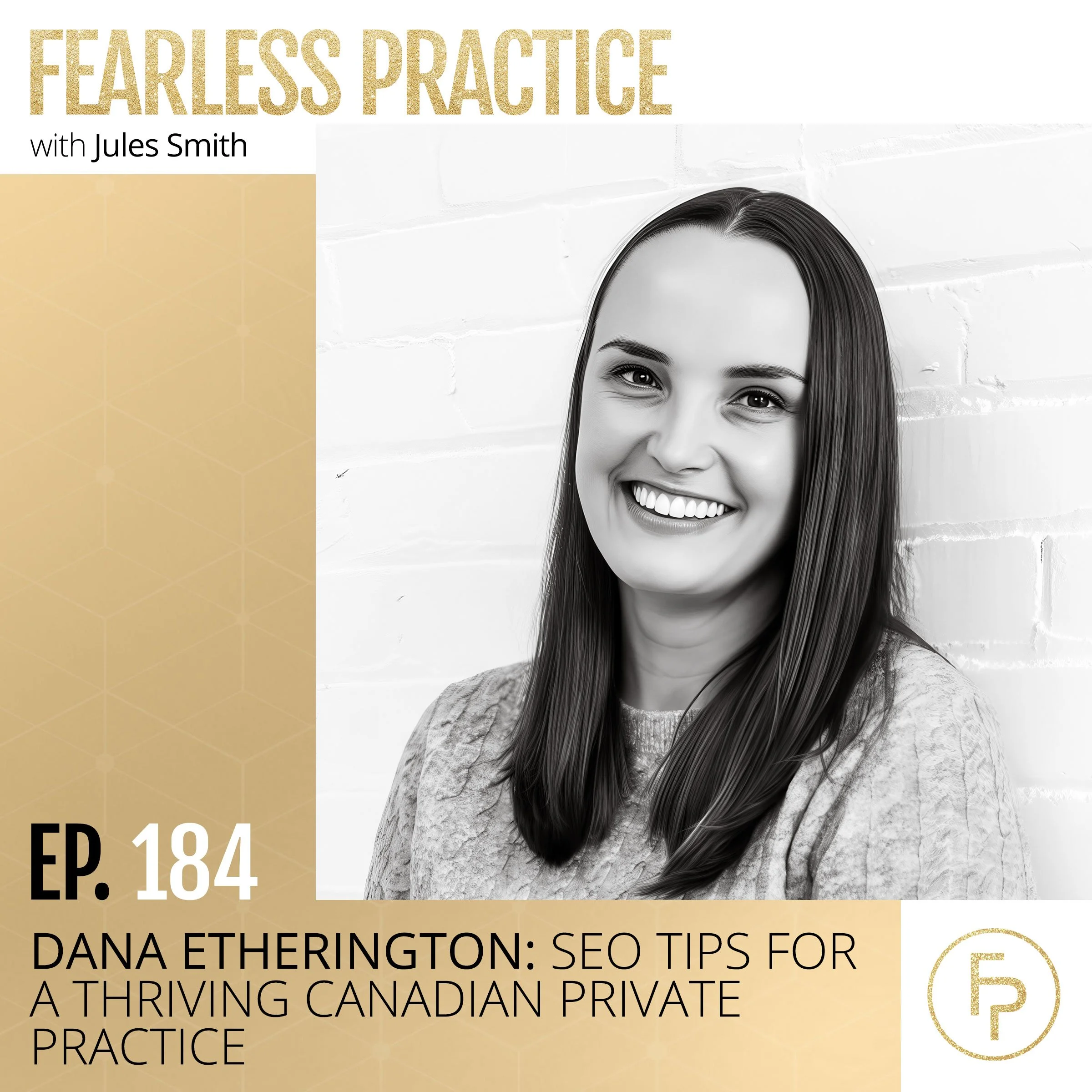
Listen to Dana’s guest podcast episode on The Fearless Practice where she talks all about SEO in therapy private practice and shares some easy to implement tips.

Looking for Clinical Supervision?
If you are a therapist seeking clinical supervision to support your psychotherapy practice, click here to learn more about this service. Our supervision services provide guidance, reflective practice, and COTO-aligned support to help you grow your skills and confidence.